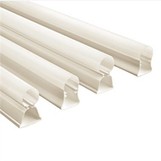

As a trusted supplier of T8 fixture housing, I often encounter a common question from customers: "Can T8 fixture housing be used with different bulbs?" This is a crucial query, as it relates to the flexibility, efficiency, and cost - effectiveness of lighting solutions. In this blog post, I will delve into this topic, exploring the compatibility of T8 fixture housing with various bulbs, and providing insights based on my experience in the industry.


Understanding T8 Fixture Housing
Before we discuss the compatibility with different bulbs, let's first understand what T8 fixture housing is. T8 refers to a type of fluorescent tube that has a diameter of 1 inch (25.4 mm). The T8 fixture housing is the structure that holds the T8 bulb in place, provides electrical connections, and often includes a reflector or diffuser to control the light distribution.
T8 fixture housings are designed to be robust and reliable, with materials ranging from aluminum for better heat dissipation to plastic for cost - effectiveness and lightweight. They come in various lengths to accommodate different bulb sizes, typically from 2 feet to 8 feet. The design of T8 fixture housing has evolved over the years to meet the changing needs of the lighting industry, including energy efficiency and environmental concerns.
Compatibility with Traditional Fluorescent Bulbs
T8 fixture housing is primarily designed for T8 fluorescent bulbs. These bulbs are a popular choice in commercial and industrial settings due to their relatively long lifespan, high lumen output, and energy efficiency compared to older incandescent bulbs. When using T8 fluorescent bulbs, the housing provides the necessary electrical ballast to start and operate the bulb.
The ballast in the T8 fixture housing is crucial for the proper functioning of the fluorescent bulb. It regulates the current flowing through the bulb, ensuring stable light output and preventing overheating. Most T8 fixture housings are compatible with standard T8 fluorescent bulbs, and the installation process is relatively straightforward. You simply insert the bulb into the sockets at each end of the housing and connect the electrical wires according to the wiring diagram.
However, it's important to note that there are different types of T8 fluorescent bulbs, such as pre - heat and rapid - start bulbs. Some T8 fixture housings may be designed specifically for one type of bulb, so it's essential to check the compatibility before making a purchase. Using an incompatible bulb may result in poor performance, such as flickering or reduced lifespan.
Compatibility with LED Bulbs
In recent years, LED technology has revolutionized the lighting industry, offering significant advantages over traditional fluorescent bulbs, including higher energy efficiency, longer lifespan, and better color rendering. Many customers are now considering replacing their T8 fluorescent bulbs with LED bulbs in their existing T8 fixture housings.
The good news is that in most cases, T8 fixture housing can be used with LED bulbs. There are two main types of LED bulbs for T8 fixture housing: direct - wire (also known as ballast - bypass) and ballast - compatible.
Direct - wire LED bulbs require the removal of the existing ballast in the T8 fixture housing. This is because LED bulbs operate on direct current (DC), while the ballast in a fluorescent fixture is designed for alternating current (AC). By bypassing the ballast, the direct - wire LED bulbs can be connected directly to the power supply. This method not only simplifies the electrical system but also reduces the risk of ballast failure, which is a common issue with fluorescent fixtures.
On the other hand, ballast - compatible LED bulbs are designed to work with the existing ballast in the T8 fixture housing. These bulbs are easier to install, as you don't need to remove the ballast. However, they may not be as energy - efficient as direct - wire LED bulbs, and the lifespan of the ballast may still be a limiting factor.
It's important to note that not all T8 fixture housings are suitable for LED conversion. Some older housings may have outdated ballasts or wiring that is not compatible with LED bulbs. Before converting to LED, it's recommended to consult a professional electrician or the manufacturer of the T8 fixture housing to ensure a safe and successful installation.
Compatibility with Other Bulb Types
While T8 fixture housing is mainly designed for T8 fluorescent and LED bulbs, there are some other bulb types that may be compatible in certain situations.
For example, some T8 fixture housings can be adapted to use T5 bulbs. T5 bulbs are smaller in diameter than T8 bulbs, but with the use of an adapter, they can be installed in a T8 fixture housing. The adapter typically includes a socket that fits the T5 bulb and a mounting mechanism to attach it to the T8 housing. However, this may require some modifications to the housing and electrical connections, so it's important to follow the manufacturer's instructions carefully.
You can find suitable Extrusion Plastic Cover, T5 LED Fixture Cover, and T5 Light Fixture Plastic Cover to enhance the performance and appearance of your fixture when using different bulbs.
Factors to Consider When Using Different Bulbs
When considering using different bulbs in T8 fixture housing, there are several factors to keep in mind:
- Electrical Compatibility: As mentioned earlier, different bulbs have different electrical requirements. Make sure the bulb and the fixture housing are electrically compatible to avoid safety hazards and poor performance.
- Heat Dissipation: LED bulbs generate less heat than fluorescent bulbs, but some high - power LED bulbs may still require proper heat dissipation. Ensure that the T8 fixture housing has adequate ventilation to prevent overheating.
- Light Output and Distribution: Different bulbs have different light output and distribution characteristics. Consider the lighting needs of your space and choose a bulb that provides the desired level of illumination and light quality.
- Cost: The cost of bulbs and the conversion process should also be taken into account. While LED bulbs may have a higher upfront cost, they can save money in the long run due to their energy efficiency and longer lifespan.
Conclusion
In conclusion, T8 fixture housing can be used with different bulbs, including traditional fluorescent bulbs, LED bulbs, and even T5 bulbs with the use of an adapter. However, it's important to ensure compatibility in terms of electrical requirements, heat dissipation, and light output. When considering a bulb replacement or conversion, it's recommended to consult a professional or the manufacturer of the T8 fixture housing to ensure a safe and successful installation.
If you are interested in purchasing T8 fixture housing or have any questions about bulb compatibility, please feel free to contact us. We are committed to providing high - quality products and professional advice to meet your lighting needs.
References
- "Lighting Handbook: Reference and Application", 9th Edition, Illuminating Engineering Society of North America.
- Manufacturer's specifications and technical documents for T8 fixture housing and various bulbs.
- Industry reports and studies on lighting technology and energy efficiency.