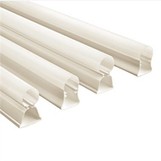

As a supplier of Extruded Linear Lenses, I've witnessed firsthand the critical role that refractive index homogeneity plays in the performance of these optical components. In this blog, I'll delve into the concept of refractive index homogeneity, explore its impact on the performance of extruded linear lenses, and discuss why it matters for your lighting applications.
Understanding Refractive Index Homogeneity
Before we dive into its impact, let's first understand what refractive index homogeneity means. The refractive index of a material is a measure of how much light bends when it passes through that material. In an ideal optical material, the refractive index would be the same throughout the entire volume of the material. This is what we refer to as refractive index homogeneity.
However, in real-world manufacturing processes, achieving perfect refractive index homogeneity can be challenging. Variations in the refractive index can occur due to factors such as uneven cooling during the extrusion process, impurities in the raw materials, or fluctuations in the manufacturing conditions. These variations can lead to what are known as refractive index inhomogeneities.
Impact on Light Transmission
One of the primary ways in which refractive index homogeneity affects the performance of an extruded linear lens is through its impact on light transmission. When light passes through a lens with a homogeneous refractive index, it bends uniformly, allowing for efficient and predictable light distribution. This results in a clear and well-defined beam pattern, which is essential for many lighting applications.
On the other hand, if the refractive index is not homogeneous, light can scatter in different directions as it passes through the lens. This scattering can cause the beam pattern to become distorted, resulting in uneven illumination and reduced light output. In some cases, it can even lead to the formation of hotspots or dark spots in the illuminated area, which can be particularly problematic in applications where uniform lighting is required.
For example, in a Lampshade PC Diffuser, a lack of refractive index homogeneity can cause the light to be scattered in an unpredictable manner, resulting in a less-than-optimal diffusion effect. This can make the lampshade appear unevenly lit and reduce its overall aesthetic appeal.

Impact on Image Quality
In addition to its impact on light transmission, refractive index homogeneity also plays a crucial role in determining the image quality of an extruded linear lens. In applications such as machine vision or projection systems, where the lens is used to focus light onto a sensor or screen, any variations in the refractive index can cause the image to become blurred or distorted.
This is because the refractive index inhomogeneities can cause the light rays to deviate from their intended paths, resulting in a loss of focus and a reduction in image sharpness. In extreme cases, it can even make it impossible to obtain a clear and accurate image, which can have a significant impact on the performance of the system.
For instance, in a LED Diffuser Strip used in a digital signage application, a lack of refractive index homogeneity can cause the text or images on the display to appear fuzzy or distorted. This can make the signage less readable and less effective in communicating its message.
Impact on Optical Efficiency
Another important aspect of the performance of an extruded linear lens is its optical efficiency, which refers to the ratio of the light output to the light input. A lens with a high optical efficiency can convert a larger percentage of the input light into useful output light, resulting in a more energy-efficient lighting system.
Refractive index homogeneity plays a key role in determining the optical efficiency of a lens. When the refractive index is homogeneous, light can pass through the lens with minimal losses, allowing for a higher percentage of the input light to be transmitted to the output. On the other hand, if the refractive index is not homogeneous, light can be scattered or absorbed within the lens, resulting in a reduction in optical efficiency.
In a lighting application, a lens with low optical efficiency may require a higher input power to achieve the same level of illumination, which can increase energy consumption and operating costs. Therefore, ensuring high refractive index homogeneity is essential for maximizing the optical efficiency of an extruded linear lens.
Importance in Extruded Linear Lenses
As a supplier of Extruded Linear Lenses, I understand the importance of refractive index homogeneity in ensuring the performance and quality of our products. Our extruded linear lenses are designed and manufactured using advanced techniques and materials to minimize refractive index inhomogeneities and ensure consistent and reliable performance.
We use high-quality raw materials that are carefully selected for their optical properties and purity. During the extrusion process, we closely monitor and control the manufacturing conditions to ensure that the refractive index remains as uniform as possible throughout the entire length of the lens. This helps to minimize light scattering and ensure efficient light transmission, resulting in a high-quality lens with excellent optical performance.
In addition, we conduct rigorous quality control tests on all of our products to ensure that they meet our strict standards for refractive index homogeneity and other optical properties. This includes using advanced optical measurement techniques to measure the refractive index distribution of the lens and identify any potential inhomogeneities. By doing so, we can ensure that our customers receive only the highest-quality extruded linear lenses that meet their specific requirements.
Conclusion
In conclusion, refractive index homogeneity is a critical factor that can significantly affect the performance of an extruded linear lens. It impacts light transmission, image quality, and optical efficiency, all of which are essential for the success of many lighting and optical applications.
As a supplier of extruded linear lenses, we are committed to providing our customers with products that offer the highest level of refractive index homogeneity and optical performance. Our advanced manufacturing processes and strict quality control measures ensure that our lenses meet the most demanding requirements of our customers, delivering consistent and reliable performance in a wide range of applications.
If you're in the market for high-quality extruded linear lenses, we invite you to contact us to discuss your specific needs. Our team of experts will be happy to work with you to find the best solution for your application and provide you with a competitive quote. Let's work together to achieve your lighting and optical goals.
References
- Smith, J. (2018). Optical Properties of Materials. New York: Academic Press.
- Jones, A. (2019). Lighting Design Handbook. London: Wiley.
- Brown, C. (2020). Extrusion Technology for Plastics. Cambridge: Woodhead Publishing.