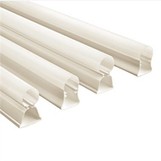

As a supplier of extruded lenses, I understand the critical importance of accurately measuring the optical performance of these products. Extruded lenses are widely used in various applications, including lighting, displays, and optical instruments. Ensuring their high - quality optical performance is not only essential for meeting customer requirements but also for maintaining a competitive edge in the market. In this blog, I will share some key methods and considerations for measuring the optical performance of extruded lenses.
1. Understanding the Key Optical Parameters
Before diving into the measurement methods, it's crucial to understand the key optical parameters that define the performance of extruded lenses.
Refractive Index
The refractive index is a fundamental property of a lens material. It determines how much light is bent when passing through the lens. A higher refractive index allows for more significant bending of light, which can be useful in designing lenses with specific focusing properties. For extruded lenses, the refractive index can affect the focal length and the overall optical power of the lens.
Transmittance
Transmittance measures the amount of light that passes through the lens. High transmittance is desirable in most applications, as it ensures that the maximum amount of light reaches the intended target. Low transmittance can lead to losses in brightness and efficiency. Factors such as material quality, surface finish, and the presence of impurities can affect the transmittance of an extruded lens.
Abbe Number
The Abbe number is a measure of the material's dispersion, which is the variation of the refractive index with wavelength. Lenses with a high Abbe number have less dispersion, resulting in less chromatic aberration. Chromatic aberration can cause color fringing and reduce the image quality, so minimizing it is crucial in applications where color accuracy is important.
Focal Length
The focal length of a lens is the distance between the lens and the point where parallel rays of light converge or appear to diverge from. Accurately measuring the focal length is essential for ensuring that the lens performs as intended in optical systems. The focal length can be affected by the curvature of the lens surfaces and the refractive index of the material.
2. Measuring Refractive Index
One of the most common methods for measuring the refractive index of an extruded lens is using a refractometer. A refractometer works by measuring the angle of refraction of light as it passes from one medium (usually air) into the lens material.
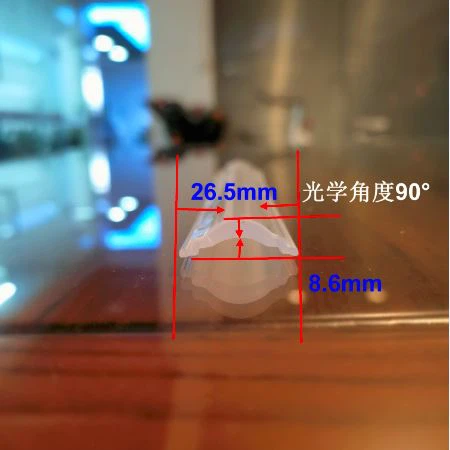

There are different types of refractometers available, including handheld and bench - top models. Handheld refractometers are portable and convenient for quick measurements, while bench - top models offer higher precision and are suitable for more accurate and detailed analysis.
To measure the refractive index using a refractometer, a small sample of the lens material is placed on the measuring prism of the refractometer. The instrument then measures the critical angle of refraction, from which the refractive index can be calculated using Snell's law.
It's important to note that the refractive index can vary with temperature, so it's necessary to control the temperature during the measurement process. Most refractometers have a built - in temperature compensation feature to account for this variation.
3. Measuring Transmittance
Transmittance can be measured using a spectrophotometer. A spectrophotometer measures the amount of light transmitted through a sample at different wavelengths.
To measure the transmittance of an extruded lens, the lens is placed in the sample holder of the spectrophotometer. A light source emits light of a specific wavelength range, and the detector measures the intensity of the light before and after passing through the lens. The transmittance is then calculated as the ratio of the transmitted light intensity to the incident light intensity.
When measuring transmittance, it's important to ensure that the lens is clean and free of any scratches or contaminants, as these can affect the measurement results. Additionally, the measurement should be taken at multiple wavelengths to obtain a comprehensive understanding of the lens's transmittance characteristics across the visible spectrum.
4. Measuring Abbe Number
Measuring the Abbe number requires measuring the refractive index at three different wavelengths: usually the Fraunhofer D (589.3 nm), F (486.1 nm), and C (656.3 nm) lines.
The Abbe number (Vd) is calculated using the formula:
[V_d=\frac{n_d - 1}{n_F - n_C}]
where (n_d), (n_F), and (n_C) are the refractive indices at the D, F, and C lines, respectively.
To measure the refractive indices at these specific wavelengths, a specialized refractometer or a spectrometer can be used. The spectrometer can provide more accurate measurements by separating the light into its component wavelengths and measuring the refractive index at each wavelength.
5. Measuring Focal Length
There are several methods for measuring the focal length of an extruded lens. One of the simplest methods is the thin - lens formula method. In this method, an object of known size is placed at a known distance from the lens, and the image formed by the lens is observed.
The thin - lens formula is given by:
[\frac{1}{f}=\frac{1}{u}+\frac{1}{v}]
where (f) is the focal length of the lens, (u) is the object distance, and (v) is the image distance.
By measuring the object distance and the image distance, the focal length can be calculated using the thin - lens formula.
Another method for measuring the focal length is the auto - collimation method. In this method, a collimated light beam is directed onto the lens, and the lens is adjusted until the reflected light beam is parallel to the incident light beam. The distance between the lens and the point where the light beam is collimated is equal to the focal length of the lens.
6. Other Considerations
In addition to the above - mentioned optical parameters, there are other factors that can affect the optical performance of extruded lenses and should be considered during the measurement process.
Surface Quality
The surface quality of an extruded lens can have a significant impact on its optical performance. Scratches, pits, and other surface defects can cause light scattering, which can reduce the transmittance and image quality. Surface roughness can also affect the reflection and refraction of light at the lens surfaces.
To ensure high - quality surface finish, it's important to use proper manufacturing processes and post - processing techniques, such as polishing. Surface profilometers can be used to measure the surface roughness and detect any surface defects.
Uniformity
The optical properties of an extruded lens should be uniform across its entire surface. Non - uniformity can lead to variations in the focal length, transmittance, and other optical parameters, which can affect the performance of the lens in optical systems.
To measure the uniformity of an extruded lens, multiple measurements can be taken at different points on the lens surface. These measurements can then be compared to ensure that the optical properties are consistent.
7. Applications and Product Examples
Extruded lenses have a wide range of applications, and different applications may require different optical performance characteristics.
For example, in lighting applications, LED Diffuser Strip are commonly used to evenly distribute light and reduce glare. These lenses need to have high transmittance and good diffusion properties. The optical performance measurements mentioned above can help ensure that the LED diffuser strips meet the required standards.
Plastic Diffuser Lens are also widely used in lighting fixtures. They can be designed to provide different light distribution patterns, such as wide - angle or narrow - angle distribution. Measuring the optical performance of these lenses is crucial for achieving the desired lighting effects.
In the case of Lampshade PC Diffuser, they need to have good light - diffusing properties while maintaining a certain level of transmittance. By accurately measuring the optical parameters, we can optimize the design and manufacturing process of these diffusers to meet the specific requirements of the lampshade.
8. Conclusion and Call to Action
Accurately measuring the optical performance of extruded lenses is a complex but essential process. By understanding the key optical parameters and using appropriate measurement methods, we can ensure that our extruded lenses meet the highest quality standards and perform as expected in various applications.
If you are in the market for high - quality extruded lenses and want to learn more about our products and how we ensure their optical performance, we encourage you to contact us for a detailed discussion. We are committed to providing you with the best solutions for your optical needs.
References
- Hecht, E. (2017). Optics. Pearson.
- Smith, W. J. (2007). Modern Optical Engineering: The Design of Optical Systems. McGraw - Hill.
- Malacara, D. (2018). Handbook of Optical Manufacturing and Testing. CRC Press.