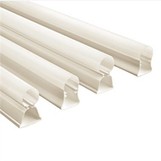

Yo! I'm a supplier in the PVC Pipe Extrusion game, and I've seen my fair share of issues with extruded PVC pipes, especially deformation. It's a real headache for both us suppliers and the customers who rely on these pipes for various applications. So, I thought I'd share what I've learned about what causes the deformation of extruded PVC pipes.
1. Material - Related Factors
First off, let's talk about the PVC material itself. The quality of the PVC resin we use is super important. If the resin has inconsistent molecular weight, it can lead to uneven melting during the extrusion process. When the material doesn't melt uniformly, some parts of the pipe will be more fluid than others. This uneven flow can cause stress points in the pipe as it cools and solidifies, resulting in deformation.
Also, the additives in the PVC compound play a big role. For example, plasticizers are added to make the PVC more flexible. But if we use too much or too little plasticizer, it can mess things up. Too much plasticizer can make the pipe too soft, and it might sag or bend under its own weight or during handling. On the other hand, too little plasticizer can make the pipe brittle, and it could crack or deform when subjected to even minor stress.
Another thing is moisture. PVC resin can absorb moisture from the air, especially in humid environments. If the material isn't properly dried before extrusion, the moisture can turn into steam during the high - temperature extrusion process. This steam creates tiny bubbles in the pipe, weakening its structure and causing it to deform more easily.
2. Extrusion Process Issues
The extrusion process is where the magic happens, but it's also where a lot of things can go wrong. One major factor is the temperature control. If the extrusion temperature is too high, the PVC material becomes overly fluid. This can lead to the pipe walls being too thin in some areas and thicker in others. As the pipe cools, the uneven thickness causes differential shrinkage, which results in deformation. For instance, if the outer layer of the pipe cools faster than the inner layer, it can create internal stresses that make the pipe warp.
The screw speed in the extruder is also crucial. If the screw turns too fast, it can cause excessive shear forces on the PVC material. These shear forces can break down the molecular structure of the PVC, making it weaker and more prone to deformation. On the contrary, if the screw speed is too slow, the material might not flow smoothly through the die, leading to non - uniform pipe formation and deformation.
The die design is yet another important aspect. A poorly designed die can cause uneven flow of the PVC material. For example, if the die has rough surfaces or uneven channels, the material will not flow evenly, resulting in a pipe with inconsistent wall thickness. This inconsistent wall thickness is a major cause of deformation. You can check out our Extrusion Plastic Profile for some examples of well - designed extrusion products.
3. Cooling and Post - Extrusion Handling
After the pipe comes out of the extruder, the cooling process is critical. If the cooling is too rapid, it can create thermal stress in the pipe. The outer surface of the pipe cools and solidifies quickly, while the inner part is still hot and fluid. This difference in temperature causes the outer layer to contract faster than the inner layer, leading to deformation. On the other hand, if the cooling is too slow, the pipe might not set properly and could sag or deform under its own weight.


Once the pipe is cooled, how we handle it also matters. If we stack the pipes too high or in an improper way, they can get crushed or bent. And if we transport the pipes without proper support or protection, they can be damaged during transit. For example, if the pipes are loaded on a truck without proper padding, they can be jostled around and deformed.
4. Environmental Factors
The environment where the pipes are used or stored can also cause deformation. High temperatures can soften the PVC pipes, making them more likely to deform under stress. For example, if the pipes are installed in an area with direct sunlight exposure, the heat from the sun can make the pipes expand and warp.
On the other hand, extremely cold temperatures can make the pipes brittle. When the pipes are cold, they lose their flexibility and can crack or break easily. And if there are sudden temperature changes, such as a rapid drop in temperature, the pipes can experience thermal shock, which can also lead to deformation.
In addition, chemical exposure can be a problem. Some chemicals can react with PVC, weakening its structure and causing it to deform. For example, if the pipes are used in an industrial environment where they come into contact with strong acids or alkalis, the chemical reaction can eat away at the PVC and make the pipes lose their shape.
5. Design and Installation Problems
The design of the pipe system itself can contribute to deformation. If the pipes are not properly sized for the application, they might be subjected to excessive stress. For example, if a pipe is too small for the flow rate of the fluid it's carrying, the pressure inside the pipe can be too high, causing it to expand or burst.
Improper installation is also a common cause. If the pipes are not installed straight or if they are not properly supported, they can sag or bend over time. For example, if the pipe brackets are too far apart, the pipe can sag under its own weight. And if the pipes are installed in an area where there is a lot of vibration, the constant shaking can cause the pipes to deform.
As a PVC Pipe Extrusion supplier, we're always working hard to ensure that our pipes are of the highest quality and free from deformation. We use top - notch materials, carefully control the extrusion process, and provide detailed installation instructions. But sometimes, despite our best efforts, issues can still arise. If you're in the market for PVC pipes, whether it's for Plastic Profile or Irregular Plastic Lampshade applications, we'd love to talk to you. We can provide you with high - quality products and help you avoid the deformation issues we've discussed. Just reach out, and let's start a conversation about your PVC pipe needs.
References
- "Plastics Extrusion Technology" by Allan A. Griff.
- "Handbook of PVC Formulating" by Edward J. Wickson.