
Hey there! As a supplier of Modified ABS, I've seen firsthand how different molding techniques can have a huge impact on the surface finish of the final product. In this blog, I'm gonna break down these effects and share some insights that'll hopefully help you make better decisions when it comes to using Modified ABS.
First off, let's talk a bit about Modified ABS. It's an amazing material that combines the great properties of ABS with some added features. You've got Flame Retardant ABS, which is super useful in applications where fire safety is a concern. Then there's Heat Resistance Grade ABS, perfect for parts that need to withstand high temperatures. And don't forget Reinforced Modified ABS, which offers enhanced strength and durability.
Now, let's dive into the molding techniques and how they affect the surface finish.
Injection Molding
Injection molding is one of the most common techniques for working with Modified ABS. It's a process where the molten plastic is injected into a mold cavity under high pressure. One of the big advantages of injection molding is that it can produce parts with a very smooth and uniform surface finish. The high pressure ensures that the plastic fills every nook and cranny of the mold, resulting in a clean and detailed surface.
However, there are also some potential issues. If the injection speed is too high, it can cause jetting, which leaves streaks or lines on the surface. And if the mold temperature isn't right, it can lead to warping or sink marks. But with proper control of the process parameters, injection molding can give you a top - notch surface finish.
Compression Molding
Compression molding involves placing a pre - measured amount of Modified ABS material into an open mold cavity. Then, the mold is closed, and pressure and heat are applied to shape the material. This technique is great for producing large and thick parts.
The surface finish from compression molding can vary. On one hand, it can create a relatively smooth surface, especially if the mold is well - polished. But on the other hand, since the material is being compressed rather than injected, there's a chance of getting some surface irregularities. For example, if the material isn't distributed evenly in the mold, it can result in uneven thickness and a less - than - perfect surface.
Extrusion Molding
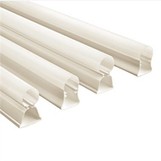
Extrusion molding is used to create continuous profiles of Modified ABS, like pipes or rods. In this process, the plastic is forced through a die to form the desired shape. The surface finish of extruded Modified ABS parts is generally smooth, but it can be affected by the condition of the die.
If the die has any scratches or rough spots, those will be transferred to the surface of the extruded part. Also, the speed of extrusion matters. A very high extrusion speed can cause the surface to look rough or even lead to melt fracture, which gives the part a shark - skin - like appearance.
Blow Molding
Blow molding is commonly used to make hollow parts, such as bottles or containers. It starts with an extruded or injection - molded parison (a tube of molten plastic). Then, air is blown into the parison to expand it and take the shape of the mold.


The surface finish in blow molding can be quite good, especially if the mold is designed well. But issues can arise if there are problems with the parison formation. For example, if the parison has uneven thickness, it can cause variations in the surface finish of the final part. Also, any impurities in the air used for blowing can leave marks on the surface.
Factors Affecting Surface Finish Beyond Molding Techniques
It's not just the molding techniques that matter. The quality of the Modified ABS material itself plays a big role. If the material has impurities or inconsistent properties, it can affect the surface finish no matter which molding technique you use.
The mold design is also crucial. A well - designed mold with proper venting can prevent air traps, which can cause surface defects. And the post - molding processes, like polishing or painting, can further enhance or correct the surface finish.
Real - World Examples
Let's look at some real - world scenarios. Say you're making a consumer electronics case using injection - molded Modified ABS. A smooth and shiny surface finish is essential for the aesthetic appeal of the product. By carefully controlling the injection molding parameters, you can achieve a surface that looks great and feels good to the touch.
On the other hand, if you're producing industrial parts using compression molding, a slightly rougher surface might be acceptable as long as the part meets the functional requirements. But even then, you'd still want to minimize any major surface irregularities.
Choosing the Right Molding Technique for Your Surface Finish Needs
When it comes to picking the right molding technique, you need to consider your specific requirements. If you need a high - end, smooth surface finish for a consumer product, injection molding is probably your best bet. But if you're making large, less - aesthetically - critical parts, compression molding could be a more cost - effective option.
Extrusion molding is ideal for continuous profiles, and blow molding is the go - to for hollow parts. By understanding the pros and cons of each technique in terms of surface finish, you can make an informed decision.
Conclusion
In conclusion, different molding techniques have distinct effects on the surface finish of Modified ABS. Whether you're aiming for a super - smooth surface for a high - end product or a more functional finish for an industrial part, there's a molding technique that can meet your needs. As a Modified ABS supplier, I'm here to help you navigate these options and ensure you get the best results.
If you're interested in using our Modified ABS products and want to discuss the best molding techniques for your project, feel free to reach out. We can have a chat about your specific requirements and figure out the perfect solution together. Whether you need Flame Retardant ABS, Heat Resistance Grade ABS, or Reinforced Modified ABS, we've got you covered.
References
- "Plastics Processing: Principles and Modeling" by Frank Throne
- "Injection Molding Handbook" by O. J. Roylance
- "Extrusion: The Definitive Processing Guide and Handbook" by Christopher Rauwendaal