

As a supplier of extruded aluminium, I've witnessed firsthand the intricate dance between extrusion ratio and the quality of the final product. Extrusion is a process where aluminium billets are forced through a die to create profiles of various shapes and sizes. The extrusion ratio, defined as the cross - sectional area of the billet divided by the cross - sectional area of the extruded profile, plays a pivotal role in determining the quality of the extruded aluminium.
Understanding the Extrusion Ratio
The extrusion ratio is a fundamental parameter in the aluminium extrusion process. It reflects the degree of deformation that the aluminium undergoes during extrusion. A high extrusion ratio means that the aluminium has to be significantly deformed to pass through the die, while a low extrusion ratio implies a relatively minor deformation.
For instance, if we have a billet with a cross - sectional area of 100 square centimeters and we extrude a profile with a cross - sectional area of 10 square centimeters, the extrusion ratio is 10:1. This ratio is crucial as it influences several aspects of the extruded aluminium, including its mechanical properties, surface finish, and dimensional accuracy.
Impact on Mechanical Properties
One of the most significant impacts of the extrusion ratio is on the mechanical properties of the extruded aluminium. When the extrusion ratio is high, the aluminium grains are elongated and refined. This grain refinement leads to an increase in the strength and hardness of the extruded profile. The reason behind this is that the smaller grains act as barriers to dislocation movement, making it more difficult for the material to deform under stress.
However, an extremely high extrusion ratio can also have negative effects. Excessive deformation can cause the formation of internal stresses within the material. These internal stresses can lead to cracking or warping of the extruded profile during subsequent processing or in service. On the other hand, a low extrusion ratio may result in a less refined grain structure, leading to lower strength and hardness.
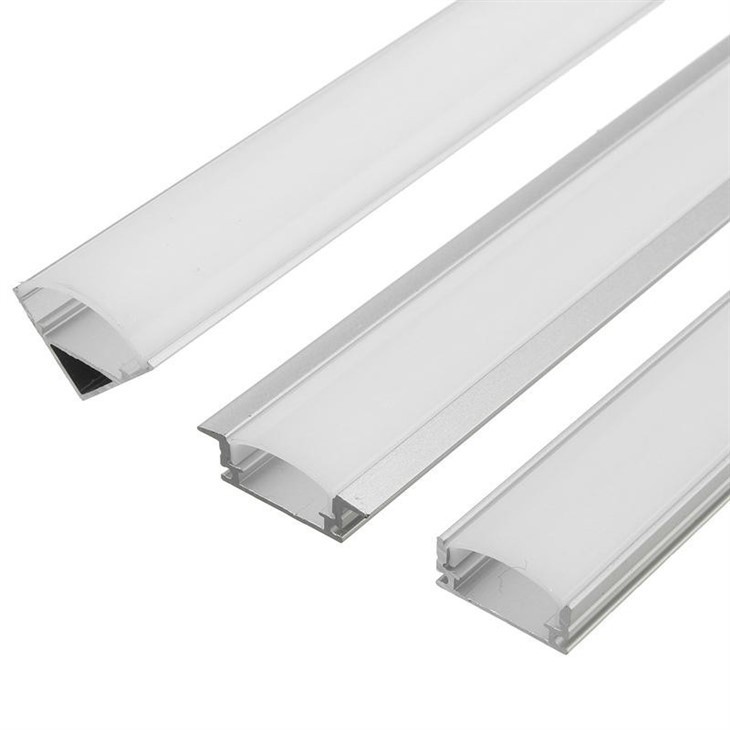
For example, in applications where high strength is required, such as in the construction of LED Aluminum Extrusion for outdoor lighting fixtures, a carefully chosen high extrusion ratio can help achieve the desired mechanical properties. But if the ratio is too high, the risk of defects increases, which can compromise the long - term performance of the product.
Influence on Surface Finish
The extrusion ratio also has a direct influence on the surface finish of the extruded aluminium. A high extrusion ratio can lead to a smoother surface finish. As the aluminium is forced through the die at a high degree of deformation, the surface irregularities are reduced. The material flows more uniformly, resulting in a more polished appearance.
Conversely, a low extrusion ratio may result in a rougher surface finish. The aluminium may not flow as smoothly through the die, leading to surface defects such as scratches, pits, or unevenness. In applications where aesthetics are important, such as Aluminum Profiles For LED Strip Lighting, a high - quality surface finish is essential. Therefore, the extrusion ratio needs to be optimized to achieve the desired visual appeal.
Effect on Dimensional Accuracy
Dimensional accuracy is another critical aspect of extruded aluminium quality. The extrusion ratio can affect how closely the final extruded profile matches the design specifications. A high extrusion ratio can lead to better dimensional accuracy in some cases. The high degree of deformation helps to ensure that the aluminium fills the die cavity more precisely, resulting in a profile with more consistent dimensions.
However, a very high extrusion ratio can also cause problems with dimensional accuracy. The internal stresses generated during high - ratio extrusion can cause the profile to distort as it cools. This distortion can lead to deviations from the intended dimensions. A low extrusion ratio may also result in dimensional inaccuracies, as the material may not flow evenly through the die, leading to variations in the cross - sectional dimensions of the profile. For LED Strip Aluminum Profile, where precise dimensions are required for proper fit and function, the extrusion ratio must be carefully controlled.
Balancing the Extrusion Ratio
Finding the optimal extrusion ratio is a delicate balancing act. It requires a deep understanding of the specific requirements of the extruded aluminium product. Factors such as the alloy composition, the shape and size of the profile, and the intended application all need to be considered.
For different aluminium alloys, the optimal extrusion ratio can vary. Some alloys are more ductile and can withstand higher extrusion ratios without significant problems, while others are more brittle and require a lower ratio to avoid defects. The shape of the profile also plays a role. Complex shapes may require a different extrusion ratio compared to simple, straight profiles.
In addition, the extrusion process parameters, such as the extrusion speed, temperature, and lubrication, also interact with the extrusion ratio. For example, a higher extrusion speed may allow for a slightly higher extrusion ratio without sacrificing quality, as long as the temperature and lubrication are properly controlled.
Our Experience as an Extruded Aluminium Supplier
As an extruded aluminium supplier, we have extensive experience in optimizing the extrusion ratio for different products. We work closely with our customers to understand their specific needs and requirements. Our team of experts conducts thorough research and testing to determine the best extrusion ratio for each project.
We use advanced extrusion equipment and monitoring systems to ensure that the extrusion process is carried out precisely. By carefully controlling the extrusion ratio and other process parameters, we are able to produce high - quality extruded aluminium profiles that meet or exceed our customers' expectations.
Contact Us for Quality Extruded Aluminium
If you are in need of high - quality extruded aluminium products, whether it's for LED Aluminum Extrusion, Aluminum Profiles For LED Strip Lighting, or LED Strip Aluminum Profile, we are here to help. Our commitment to quality and customer satisfaction is unwavering. Contact us to discuss your project requirements and let us provide you with the best extruded aluminium solutions.

References
- Smith, J. (2018). Aluminium Extrusion Technology. Publisher: Metal Press.
- Johnson, R. (2019). The Impact of Process Parameters on Aluminium Extrusion Quality. Journal of Materials Science, 45(2), 123 - 135.
- Brown, A. (2020). Optimizing Extrusion Ratios for Aluminium Profiles. International Journal of Extrusion Engineering, 10(3), 78 - 89.


