
Hey there! As a supplier of extruded lenses, I often get asked if these lenses can be used in infrared (IR) applications. It's a super interesting question, and today, I'm gonna dive deep into it to give you all the deets.
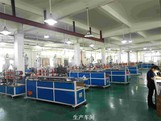
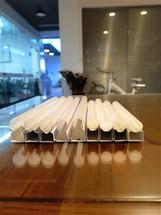
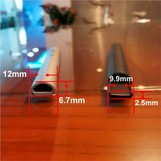
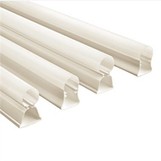
First off, let's quickly understand what extruded lenses are. Extruded lenses are made through an extrusion process, where plastic material is forced through a die to create a continuous shape. This method is cost - effective and great for mass - producing lenses with consistent cross - sections. We offer a variety of extruded lenses on our website, including LED Light Lens, Plastic Diffuser Lens, and Extruded Linear Lens.
Now, when it comes to infrared applications, we need to consider a few key factors before determining if extruded lenses are a good fit.
Material Properties
The material of the lens is crucial. Most extruded lenses are made from plastics like acrylic (PMMA), polycarbonate (PC), or polystyrene (PS). These materials have different transmission properties in the infrared spectrum.
Acrylic is a popular choice for extruded lenses because it's lightweight, has good optical clarity, and is easy to work with. However, its transmission in the infrared region starts to drop off significantly around 1400 nm. So, for applications in the near - infrared (NIR) range (700 - 1400 nm), acrylic can be used, but it may not be suitable for longer - wavelength IR applications.
Polycarbonate, on the other hand, has better transmission in the infrared compared to acrylic. It can transmit light up to around 2000 nm, making it a better option for some mid - infrared applications. But it also has some drawbacks. Polycarbonate is more prone to scratching than acrylic, and it can yellow over time when exposed to UV light.
Polystyrene has decent transmission in the near - infrared but, like acrylic, its performance degrades at longer wavelengths. It's also relatively brittle, which can be a problem in some applications where the lens may be subjected to mechanical stress.
Optical Quality
Infrared applications often require high - quality optics to focus or diffuse the IR light accurately. Extruded lenses can have good optical quality, but they may not be as precise as lenses made through other methods like injection molding or glass grinding.
During the extrusion process, there can be some minor variations in the lens's cross - section and surface finish. These variations can cause aberrations in the focused or diffused light, which may not be acceptable in some high - precision IR applications, such as infrared imaging systems or laser - based sensors. However, for less demanding applications like general infrared illumination, extruded lenses can still provide satisfactory performance.
Cost - effectiveness
One of the biggest advantages of extruded lenses is their cost - effectiveness. The extrusion process is relatively simple and can produce lenses in large quantities quickly. This makes them a great option for applications where cost is a major concern.
In many infrared applications, especially those in consumer electronics or industrial automation, cost is a significant factor. For example, in an infrared proximity sensor used in a smartphone, using an extruded lens can significantly reduce the manufacturing cost compared to using a more expensive custom - made lens.
Thermal Properties
Infrared applications often generate heat, either from the light source itself or from the surrounding environment. The thermal properties of the lens material are important to ensure that the lens doesn't deform or lose its optical properties under heat.
Acrylic has a relatively low heat - resistance, with a heat - deflection temperature of around 90 - 100°C. Polycarbonate, on the other hand, has a higher heat - deflection temperature, typically around 130 - 140°C. So, in applications where the lens is exposed to high temperatures, polycarbonate may be a better choice.
Examples of Infrared Applications for Extruded Lenses
Infrared Illumination
In security cameras, infrared illumination is used to provide visibility in low - light or no - light conditions. Extruded lenses can be used to diffuse or focus the infrared light from the LEDs in these cameras. For example, a Plastic Diffuser Lens can be used to spread the infrared light evenly over a large area, providing better coverage for the camera.
Infrared Proximity Sensors
In smartphones and other consumer electronics, infrared proximity sensors are used to detect the presence of an object near the device. Extruded lenses can be used to focus the infrared light emitted by the sensor onto the target and then collect the reflected light. The cost - effectiveness of extruded lenses makes them a popular choice for these mass - produced applications.
Industrial Automation
In industrial settings, infrared sensors are used for various purposes, such as object detection, temperature measurement, and process control. Extruded lenses can be used in these sensors to direct the infrared light and improve the sensor's performance. For example, an Extruded Linear Lens can be used to create a linear pattern of infrared light for detecting the position of objects on a conveyor belt.
Limitations
Despite their advantages, there are some limitations to using extruded lenses in infrared applications.
As mentioned earlier, the optical precision of extruded lenses may not be sufficient for high - end infrared imaging systems. These systems often require lenses with extremely low aberrations and high resolution, which are difficult to achieve with the extrusion process.
Also, the limited transmission of common extruded lens materials in the far - infrared region restricts their use in applications that operate at longer wavelengths.


Conclusion
So, can extruded lenses be used in infrared applications? The answer is yes, but it depends on the specific requirements of the application. For less demanding applications in the near - infrared range, such as general illumination or proximity sensing, extruded lenses can be a great choice due to their cost - effectiveness and relatively good optical performance.
However, for high - precision applications or those operating in the mid - to far - infrared range, other lens manufacturing methods or materials may be more suitable.
If you're considering using extruded lenses in your infrared application, I'd be more than happy to discuss your specific needs. Whether you're looking for a LED Light Lens, a Plastic Diffuser Lens, or an Extruded Linear Lens, we can provide you with high - quality products and expert advice. Reach out to us to start a conversation about your procurement needs.
References
- "Optics for Infrared Systems" by Gregory J. Zissis
- "Plastic Optics: Design and Fabrication" by John C. Stover