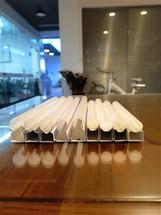

Do extruded lenses have good light transmission? Well, that's a question I get asked a lot as a supplier of extruded lenses. I've been in this business for quite a while, and I'm more than happy to share my insights on this topic.
Let's start with the basics. Extruded lenses are made through a process called extrusion, where plastic materials are melted and forced through a die to create a specific shape. This method allows for the production of lenses in various sizes and shapes, making them versatile for different applications.
When it comes to light transmission, extruded lenses have some pretty awesome features. First off, the materials used in extruded lenses are carefully selected for their optical properties. Most of the time, we use high - quality plastics like polycarbonate or acrylic. These plastics are known for their excellent light - transmitting capabilities.
Polycarbonate, for example, can transmit up to 90% of visible light. That's a pretty high percentage! It means that when light passes through a polycarbonate extruded lens, most of it gets through, and you get a bright and clear output. Acrylic is another great option. It has a light transmission rate of around 92%, which is even better in some cases. This high light transmission is crucial in applications where you need to maximize the amount of light that reaches the target area.
One of the things that affect light transmission in extruded lenses is the surface quality. During the extrusion process, we pay close attention to ensuring a smooth surface finish. Any roughness or imperfections on the surface can cause light to scatter. When light scatters, it doesn't travel in a straight line, and some of it gets lost in different directions. This can result in a dimmer or less focused light output. But with our advanced extrusion techniques, we're able to produce lenses with a very smooth surface, which helps maintain good light transmission.
Another factor is the thickness of the lens. In general, thinner extruded lenses tend to have better light transmission. As light passes through a thicker lens, there's a higher chance of absorption and scattering within the material. However, we understand that in some applications, a certain thickness is required for structural integrity or other reasons. So, we work on optimizing the design to balance between thickness and light transmission.
Now, let's talk about some of the specific types of extruded lenses we offer and how their light transmission plays a role in their applications.
The Plastic Diffuser Lens is designed to spread light evenly. It has a special surface pattern or internal structure that scatters the light in a controlled way. Even though it scatters the light, it still maintains a good level of light transmission. This is important in applications like backlighting for displays. You want the light to be evenly distributed across the display surface without losing too much brightness.
The LED Diffuser Strip is often used in LED lighting fixtures. LEDs are known for their high - intensity light, but they can also create hotspots. The LED diffuser strip helps to diffuse the light from the LEDs, making the lighting more uniform. And thanks to its good light transmission, it doesn't significantly reduce the overall brightness of the LEDs.
The Extruded Linear Lens is commonly used in linear lighting applications, such as in commercial buildings or industrial settings. It focuses and directs the light in a linear pattern. Good light transmission is essential here because you want to ensure that the light travels the desired distance and covers the intended area without a significant loss of intensity.
In addition to the materials and design, we also perform quality control tests on our extruded lenses. We use specialized equipment to measure the light transmission rate of each batch of lenses. This way, we can guarantee that the lenses we supply meet the high - quality standards our customers expect.
To sum it up, extruded lenses do have good light transmission. Thanks to the use of high - quality materials, careful manufacturing processes, and strict quality control, our extruded lenses are able to transmit a large percentage of light. Whether you're looking for a lens to diffuse light, focus it, or direct it in a specific pattern, our extruded lenses can provide a reliable solution.
If you're in the market for extruded lenses and are interested in learning more about how they can meet your specific needs, I'd love to have a chat with you. Whether it's for a small - scale project or a large - scale industrial application, we have the expertise and the products to help you out. Just reach out, and we can start discussing your requirements.
References


- Optical Properties of Polycarbonate and Acrylic Plastics, Journal of Plastic Optics
- Extrusion Techniques for High - Quality Lens Production, International Journal of Manufacturing Technology