

As a trusted extruded lens supplier, ensuring the dimensional accuracy of our products is of utmost importance. Dimensional accuracy directly impacts the performance, functionality, and compatibility of extruded lenses in various applications, such as in LED Diffuser Strip, LED Light Lens, and Plastic Diffuser Lens. In this blog, I will share some key strategies and practices that we adopt to guarantee the dimensional accuracy of our extruded lenses.
Understanding the Importance of Dimensional Accuracy
Before delving into the methods of ensuring dimensional accuracy, it is essential to understand why it matters. In the field of optics, even the slightest deviation from the specified dimensions can lead to significant issues. For example, in LED lighting applications, an extruded lens with inaccurate dimensions may cause uneven light distribution, reduced light efficiency, or improper fitting with the lighting fixture. This can result in sub - optimal performance and customer dissatisfaction. Moreover, in precision optical instruments, dimensional inaccuracies can lead to distorted images or inaccurate measurements. Therefore, maintaining high - level dimensional accuracy is crucial for the success of our products in the market.
Material Selection
The choice of material is the first step in ensuring dimensional accuracy. Different plastics have different properties, such as thermal expansion coefficients, shrinkage rates, and mechanical strengths. For extruded lenses, we carefully select materials that have low shrinkage rates and stable physical properties during the extrusion process. For instance, polycarbonate (PC) and acrylic (PMMA) are popular choices for their good optical clarity and relatively low shrinkage.
We work closely with our material suppliers to source high - quality raw materials. Before using a new batch of material, we conduct thorough material testing. This includes measuring the melt flow index, density, and thermal properties. By ensuring the consistency of the raw material, we can minimize the variations in the extrusion process that could lead to dimensional inaccuracies.
Extrusion Process Optimization
The extrusion process is a critical stage where dimensional accuracy is determined. Here are some aspects of the extrusion process that we focus on:
Screw Design and Operation
The screw in the extruder plays a vital role in melting and conveying the plastic material. We use screws with optimized designs for different materials. The screw speed, temperature, and pressure are precisely controlled. A consistent screw speed ensures a uniform flow of the molten plastic, which is essential for maintaining dimensional stability. For example, if the screw speed is too high, it may cause uneven melting and flow of the plastic, resulting in irregularities in the extruded lens dimensions.

Die Design
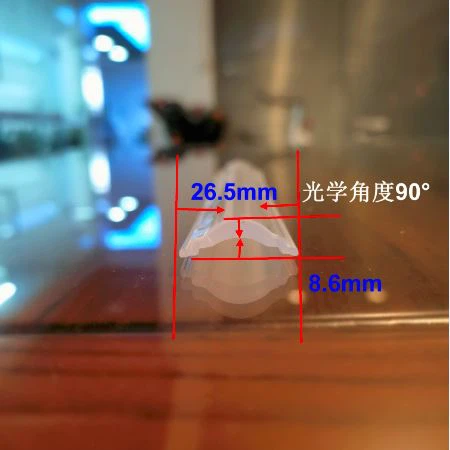
The die is the tool that shapes the extruded plastic into the desired lens profile. We use advanced CAD/CAM technology to design the die with high precision. The die must be carefully machined to ensure smooth internal surfaces and accurate dimensions. During the extrusion process, the temperature of the die is also controlled. Any temperature variations in the die can cause the plastic to expand or contract unevenly, leading to dimensional changes. We use heating and cooling systems around the die to maintain a stable temperature environment.
Cooling and Calibration
After the plastic is extruded through the die, it needs to be cooled rapidly to set its shape. However, the cooling process must be carefully controlled. Uneven cooling can cause internal stresses in the lens, which may lead to warping or dimensional changes over time. We use a calibration system to ensure that the extruded lens maintains its shape during cooling. The calibration system typically consists of a series of sizing tools and cooling baths. The sizing tools help to maintain the correct dimensions of the lens as it cools, while the cooling baths provide a controlled cooling rate.
In - process Quality Control
During the extrusion process, we implement a comprehensive in - process quality control system. This includes:
Real - time Monitoring
We use sensors and monitoring devices to continuously measure the dimensions of the extruded lens. For example, laser gauges can be used to measure the thickness, width, and diameter of the lens in real - time. If the measured dimensions deviate from the specified values, the extrusion process can be immediately adjusted. This real - time feedback loop allows us to correct any potential dimensional issues before they become significant problems.
Sampling and Inspection
In addition to real - time monitoring, we also take regular samples of the extruded lenses for detailed inspection. These samples are measured using precision measuring instruments, such as coordinate measuring machines (CMM). The CMM can accurately measure the three - dimensional dimensions of the lens and detect any minute deviations. We compare the measured values with the design specifications and calculate the dimensional tolerance. If the tolerance is exceeded, we stop the production process and investigate the root cause.
Post - extrusion Processing
After the extrusion process, some post - extrusion processing steps may be required to further improve dimensional accuracy.
Annealing
Annealing is a heat - treatment process that can relieve internal stresses in the lens. By heating the lens to a specific temperature and then slowly cooling it, we can reduce the internal stresses caused by the extrusion and cooling processes. This helps to prevent warping and ensures dimensional stability over time.
Machining
In some cases, we may perform precision machining operations on the extruded lens, such as cutting, grinding, or polishing. These operations can be used to achieve more precise dimensions and surface finishes. However, we must be careful during machining to avoid introducing new dimensional errors. We use high - precision machining equipment and follow strict machining procedures.
Quality Management System
We have established a comprehensive quality management system based on international standards, such as ISO 9001. This system ensures that every aspect of our production process, from material procurement to product delivery, is subject to strict quality control.
Our quality management system includes regular internal audits and external certifications. We train our employees on quality control procedures and encourage them to participate in continuous improvement initiatives. By having a strong quality management system in place, we can ensure that our extruded lenses consistently meet the high - level dimensional accuracy requirements.
Customer Feedback and Continuous Improvement
Customer feedback is a valuable source of information for us to improve our products and processes. We actively collect feedback from our customers regarding the dimensional accuracy of our extruded lenses. If a customer reports any dimensional issues, we conduct a detailed investigation. We analyze the production records, inspection data, and customer usage scenarios to identify the root cause of the problem.
Based on the analysis results, we implement corrective and preventive actions. This may involve adjusting the extrusion process parameters, modifying the die design, or changing the material supplier. We also use statistical process control (SPC) techniques to analyze the production data over time. By identifying trends and patterns in the dimensional variations, we can take proactive measures to prevent future issues.
Conclusion
Ensuring the dimensional accuracy of extruded lenses is a complex but essential task. Through careful material selection, optimized extrusion processes, in - process quality control, post - extrusion processing, and a strong quality management system, we are able to produce extruded lenses with high - level dimensional accuracy. As an extruded lens supplier, we are committed to providing our customers with products that meet their strict requirements.
If you are interested in our LED Diffuser Strip, LED Light Lens, or Plastic Diffuser Lens products, or if you have any questions regarding dimensional accuracy or other aspects of our products, please feel free to contact us for procurement discussions. We look forward to collaborating with you to meet your optical needs.
References
- "Plastics Extrusion Technology" by Allan A. Griff
- "Optical Plastics: Properties and Applications" by C. W. Tang
- ISO 9001:2015 Quality management systems - Requirements


