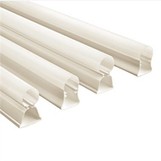

In the lighting industry, the durability and performance of lighting fixtures are of utmost importance. As a dedicated T5 Fixture Housing supplier, I've encountered numerous inquiries about the UV resistance of our products. This blog aims to delve into the scientific aspects of whether T5 Fixture Housing is resistant to UV rays, providing valuable insights for both professionals and consumers in the lighting field.
Understanding UV Rays and Their Impact on Materials
Ultraviolet (UV) rays are a part of the electromagnetic spectrum with wavelengths shorter than visible light. They are classified into three types: UVA (320 - 400 nm), UVB (280 - 320 nm), and UVC (100 - 280 nm). UVC rays are mostly absorbed by the Earth's atmosphere, while UVA and UVB rays can reach the surface and cause various effects on materials.
When materials are exposed to UV rays, several chemical and physical changes can occur. For plastics, which are commonly used in T5 Fixture Housing, UV exposure can lead to degradation. This degradation is often manifested as discoloration, loss of mechanical properties such as strength and flexibility, and surface cracking. Over time, these changes can compromise the structural integrity and aesthetic appeal of the fixture housing.
Factors Affecting UV Resistance of T5 Fixture Housing
Material Composition
The choice of material is a crucial factor in determining the UV resistance of T5 Fixture Housing. Different plastics have varying levels of inherent UV resistance. For example, polycarbonate (PC) is known for its relatively good UV resistance. It has a chemical structure that can absorb and dissipate UV energy to some extent, preventing it from causing significant damage to the material. On the other hand, some types of acrylic plastics may be more susceptible to UV degradation, especially if they are not properly formulated.
As a T5 Fixture Housing supplier, we carefully select materials based on their UV resistance properties. Our R & D team conducts extensive research to identify the most suitable plastics that can withstand long - term UV exposure without significant deterioration.
Additives
To enhance the UV resistance of T5 Fixture Housing, additives are often incorporated into the plastic material. UV stabilizers are one of the most common additives used. These stabilizers work by either absorbing UV radiation or quenching the free radicals generated by UV exposure. Hindered amine light stabilizers (HALS) are widely used in the plastics industry due to their excellent performance in preventing UV - induced degradation.
In addition to UV stabilizers, pigments can also play a role in UV resistance. Some pigments have the ability to absorb UV rays, providing an additional layer of protection to the plastic matrix. However, the choice of pigments needs to be carefully considered, as some pigments may interact with the plastic or other additives and affect the overall performance of the fixture housing.
Manufacturing Process
The manufacturing process of T5 Fixture Housing can also influence its UV resistance. For example, proper extrusion and molding techniques ensure a uniform distribution of additives and a consistent material structure. If the manufacturing process is not well - controlled, there may be areas in the fixture housing where the material is more vulnerable to UV damage.
Our manufacturing facilities are equipped with state - of - the - art equipment and follow strict quality control procedures. This ensures that each T5 Fixture Housing we produce has a high level of UV resistance and meets the industry standards.
Testing and Certification
To provide reliable information about the UV resistance of our T5 Fixture Housing, we conduct rigorous testing. One of the common testing methods is the accelerated weathering test. In this test, samples of the fixture housing are exposed to high - intensity UV light in a controlled environment for a specific period. The samples are then evaluated for changes in color, gloss, and mechanical properties.
We also seek relevant certifications to demonstrate the quality and UV resistance of our products. Certifications from recognized organizations such as UL (Underwriters Laboratories) and CE (Conformité Européene) indicate that our T5 Fixture Housing has passed strict quality and safety standards, including UV resistance requirements.
Comparison with Other Fixture Housings
When considering the UV resistance of T5 Fixture Housing, it's interesting to compare it with other types of fixture housings, such as T8 Fixture Housing. While the basic principles of UV resistance apply to both, there may be differences due to the size, design, and material selection.
T8 Fixture Housing is generally larger than T5 Fixture Housing, which may affect the distribution of UV exposure and the overall stress on the material. However, with proper material selection and additive incorporation, both T5 and T8 Fixture Housings can achieve good UV resistance.
Another related product is the T8 Light Fixture Cover. Similar to the fixture housing, the cover also needs to be resistant to UV rays to maintain its transparency and structural integrity. Our T5 and T8 light fixture covers are designed with UV - resistant materials to ensure long - term performance.
Applications and UV Exposure
The UV resistance of T5 Fixture Housing is particularly important in applications where the fixtures are exposed to sunlight or other sources of UV radiation. For example, in outdoor lighting applications such as streetlights, garden lights, and architectural lighting, the fixture housing needs to withstand continuous UV exposure over many years.
In indoor applications, although the UV exposure is generally lower than outdoors, there may still be some sources of UV light, such as fluorescent lamps and some types of LED lights. In these cases, T5 Fixture Housing with good UV resistance can prevent premature degradation and ensure the long - term functionality and appearance of the lighting fixtures.
Our Commitment as a Supplier
As a T5 Fixture Housing supplier, we are committed to providing high - quality products with excellent UV resistance. We invest heavily in research and development to continuously improve our materials and manufacturing processes. Our team of experts is always ready to provide technical support and advice to our customers regarding the selection and application of T5 Fixture Housing.
We also offer a wide range of T5 Light Fixture Plastic Cover options that are designed to complement our fixture housings and provide additional protection against UV rays.
Conclusion
In conclusion, T5 Fixture Housing can be resistant to UV rays, but it depends on several factors such as material composition, additives, and manufacturing process. Through careful material selection, the use of appropriate additives, and strict quality control in manufacturing, we can produce T5 Fixture Housing that can withstand long - term UV exposure without significant degradation.
If you are in the market for high - quality T5 Fixture Housing or related products, we invite you to contact us for more information and to discuss your specific requirements. Our team is eager to assist you in finding the best lighting solutions for your projects.


References
- ASTM International. (20XX). Standard test methods for accelerated weathering of plastics using fluorescent ultraviolet (UV) lamps.
- Plastics Industry Association. (20XX). Guide to UV resistance in plastics.
- Ullmann's Encyclopedia of Industrial Chemistry. (20XX). Plastics and UV degradation.