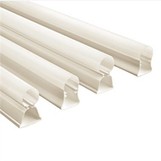

As a leading supplier of Extruded Linear Lenses, I am often asked about the dispersion property of these lenses. In this blog post, I will delve into what dispersion is, how it affects extruded linear lenses, and why it matters in various applications.
Understanding Dispersion
Dispersion is the phenomenon where light is separated into its component colors as it passes through a medium. This occurs because different wavelengths of light travel at different speeds through a material, causing them to refract at different angles. The most common example of dispersion is the rainbow, where sunlight is dispersed by water droplets in the atmosphere, creating a spectrum of colors.
In the context of extruded linear lenses, dispersion can have both positive and negative effects. On one hand, controlled dispersion can be used to create unique lighting effects, such as color mixing or beam shaping. On the other hand, unwanted dispersion can cause color fringing or reduce the overall clarity of the light output.
Factors Affecting Dispersion in Extruded Linear Lenses
Several factors can influence the dispersion property of an extruded linear lens. These include:
Material Properties
The type of material used to manufacture the lens plays a crucial role in determining its dispersion characteristics. Different plastics have different refractive indices and dispersion coefficients, which affect how light is dispersed as it passes through the lens. For example, polycarbonate (PC) and acrylic (PMMA) are two commonly used materials in extruded linear lenses. PC generally has a higher dispersion coefficient than PMMA, which means it will disperse light more significantly.
Lens Design
The shape and geometry of the lens can also impact its dispersion properties. Lenses with complex curves or multiple surfaces can cause light to refract and disperse in different ways. For instance, a lens with a prism-like structure can be designed to disperse light into a specific pattern, such as a rainbow or a wide-angle beam.
Wavelength of Light
The dispersion of light is wavelength-dependent, meaning that different colors of light will be dispersed to different degrees. Shorter wavelengths (such as blue and violet light) are typically dispersed more than longer wavelengths (such as red and orange light). This is why the blue end of the spectrum is often more spread out in a rainbow.
Applications of Dispersion in Extruded Linear Lenses
Dispersion can be utilized in a variety of applications to achieve specific lighting effects or performance requirements. Some common applications include:
Architectural Lighting
In architectural lighting, extruded linear lenses with controlled dispersion can be used to create unique and visually appealing lighting installations. For example, a lens with a rainbow dispersion effect can be used to add a touch of color and drama to a building facade or interior space.


Signage and Displays
Dispersion can also be used in signage and displays to enhance visibility and attract attention. A lens with a wide-angle dispersion pattern can be used to spread light evenly across a large area, making the sign or display more visible from different angles.
Horticultural Lighting
In horticultural lighting, the dispersion property of extruded linear lenses can be optimized to provide the right spectrum of light for plant growth. Different wavelengths of light have different effects on plant development, and a lens with the appropriate dispersion characteristics can help ensure that plants receive the optimal amount of light at each stage of growth.
Controlling Dispersion in Extruded Linear Lenses
As a supplier of extruded linear lenses, we understand the importance of controlling dispersion to meet the specific needs of our customers. To achieve this, we employ several techniques, including:
Material Selection
We carefully select the materials used in our lenses based on their dispersion properties and other performance characteristics. By choosing the right material, we can minimize unwanted dispersion and ensure that the lens provides the desired lighting effect.
Precision Manufacturing
Our manufacturing process is designed to produce lenses with high precision and consistency. We use advanced extrusion techniques and quality control measures to ensure that each lens meets our strict specifications. This helps to minimize variations in dispersion and other optical properties.
Custom Design
We offer custom design services to meet the unique requirements of our customers. Our team of engineers and designers can work with you to develop a lens with the specific dispersion characteristics and performance features you need. Whether you need a lens with a specific dispersion pattern or a lens that minimizes dispersion for maximum clarity, we can help.
Our Product Range
We offer a wide range of extruded linear lenses, including Plastic Diffuser Lens, LED Light Lens, and Lampshade PC Diffuser. These lenses are designed to provide excellent optical performance and durability, and they can be customized to meet your specific needs.
Conclusion
The dispersion property of an extruded linear lens is an important factor to consider when selecting a lens for your lighting application. By understanding how dispersion works and how it can be controlled, you can choose a lens that provides the desired lighting effect and performance. As a leading supplier of extruded linear lenses, we are committed to providing our customers with high-quality products and customized solutions. If you have any questions or need assistance in selecting the right lens for your application, please do not hesitate to contact us. We look forward to working with you to meet your lighting needs.
References
- Smith, J. (2018). Optics for Engineers. Wiley.
- Hecht, E. (2017). Optics. Addison-Wesley.
- Saleh, B. E. A., & Teich, M. C. (2019). Fundamentals of Photonics. Wiley.