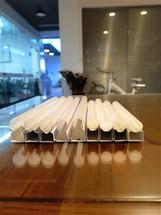

What is the light - scattering ability of plastic light covers?
As a supplier of plastic light covers, I've witnessed firsthand the significance of light - scattering ability in these products. In this blog, I'll delve into what light - scattering ability is, why it matters for plastic light covers, and how it impacts the overall lighting experience.
Understanding Light Scattering
Light scattering is a phenomenon where light is redirected in different directions as it passes through or interacts with a medium. When it comes to plastic light covers, this medium is the plastic material itself. There are two main types of light scattering relevant to plastic light covers: Rayleigh scattering and Mie scattering.


Rayleigh scattering occurs when the particles or irregularities in the medium are much smaller than the wavelength of the incident light. This type of scattering is responsible for the blue color of the sky, as shorter - wavelength blue light is scattered more effectively than longer - wavelength red light. In plastic light covers, Rayleigh scattering can contribute to a soft, diffused glow, especially when the plastic has microscopic impurities or a non - uniform molecular structure.
Mie scattering, on the other hand, happens when the size of the scattering particles is comparable to the wavelength of the light. This type of scattering is more effective at scattering light in all directions, and it can result in a more uniform distribution of light. Plastic light covers can be engineered to have a specific amount of Mie scattering by controlling the size and distribution of additives or internal structures within the plastic.
Why Light - Scattering Ability Matters
The light - scattering ability of plastic light covers is crucial for several reasons. Firstly, it improves the visual comfort of the lighting. Without proper light scattering, a direct view of the light source can be harsh and cause glare, which is not only uncomfortable but can also lead to eye strain. A plastic light cover with good light - scattering properties diffuses the light, reducing glare and creating a more pleasant and relaxing lighting environment.
Secondly, light scattering enhances the aesthetic appeal of the lighting fixture. It can transform a simple, utilitarian light source into a beautiful and decorative element. For example, a plastic light cover with a unique light - scattering pattern can add a touch of elegance to a room, creating a warm and inviting atmosphere.
Thirdly, it helps to achieve a more uniform light distribution. In many lighting applications, such as in offices, warehouses, and retail spaces, a uniform illumination is essential. A plastic light cover with excellent light - scattering ability can spread the light evenly across a large area, eliminating dark spots and ensuring that every corner of the space is well - lit.
Factors Affecting Light - Scattering Ability
Several factors can influence the light - scattering ability of plastic light covers. The type of plastic material is one of the most important factors. Different plastics have different optical properties, and some are more effective at scattering light than others. For example, polycarbonate and acrylic are commonly used in plastic light covers because they have good transparency and can be easily engineered to have the desired light - scattering characteristics.
The additives used in the plastic also play a significant role. Additives such as diffusing agents can be incorporated into the plastic during the manufacturing process to increase its light - scattering ability. These diffusing agents can be in the form of microscopic particles or polymers that are designed to scatter light in a specific way.
The thickness and surface texture of the plastic light cover can also affect its light - scattering performance. A thicker cover may scatter more light, but it may also reduce the overall light transmission. The surface texture can either enhance or reduce the light - scattering effect. For example, a matte - finish surface can increase light scattering, while a smooth, polished surface may reduce it.
Applications of Plastic Light Covers with Different Light - Scattering Abilities
Plastic light covers with different light - scattering abilities are used in a wide range of applications. In residential lighting, light covers with a high degree of light scattering are often used in pendant lights, chandeliers, and table lamps to create a soft, warm glow. These covers can help to create a cozy and inviting atmosphere in living rooms, bedrooms, and dining areas.
In commercial lighting, such as in offices and retail stores, plastic light covers with a more uniform light - scattering ability are preferred. They can ensure that the entire space is well - lit, making it easier for people to work or shop. For example, T5 tube covers, which you can learn more about at T5 Tube Cover and T5 Tube Plastic Cover, are commonly used in fluorescent lighting fixtures to provide a uniform and glare - free illumination.
In industrial lighting, plastic light covers need to be durable and have a good balance between light scattering and light transmission. They are used in factories, warehouses, and parking lots to provide reliable and efficient lighting.
Our Offerings as a Plastic Light Cover Supplier
As a supplier of plastic light covers, we understand the importance of light - scattering ability and offer a wide range of products to meet different customer needs. Our plastic light covers are made from high - quality materials, such as polycarbonate and acrylic, and are engineered to have the optimal light - scattering properties.
We work closely with Plastic Profile Extrusion Companies to ensure that our manufacturing processes are precise and efficient. We can customize the light - scattering ability of our products based on your specific requirements, whether you need a high - scattering cover for a decorative application or a more uniform - scattering cover for a commercial space.
Our team of experts is always available to provide technical support and advice on choosing the right plastic light cover for your project. We are committed to delivering products that not only meet but exceed your expectations in terms of light - scattering performance, durability, and aesthetics.
Conclusion
The light - scattering ability of plastic light covers is a critical factor that affects the visual comfort, aesthetic appeal, and light distribution of lighting fixtures. By understanding the principles of light scattering and the factors that influence it, you can make an informed decision when choosing plastic light covers for your lighting applications.
Whether you are an architect, interior designer, or a lighting contractor, we invite you to connect with us to discuss your plastic light cover needs. We are confident that our products and expertise can help you achieve the perfect lighting solution for your project.
References
- Bohren, C. F., & Huffman, D. R. (1983). Absorption and Scattering of Light by Small Particles. Wiley - Interscience.
- van de Hulst, H. C. (1957). Light Scattering by Small Particles. Dover Publications.