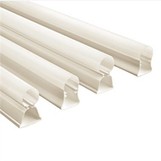

Hey there! As a supplier of T8 Fixture Housing, I often get asked about the power factor of these fixtures. So, I thought I'd take a moment to break it down for you in a way that's easy to understand.
First off, let's talk about what power factor actually is. In simple terms, power factor is a measure of how effectively electrical power is being used in a circuit. It's expressed as a number between 0 and 1, with 1 being the ideal value. A power factor of 1 means that all the electrical power being supplied to the circuit is being used efficiently, while a lower power factor indicates that some of the power is being wasted.
Now, when it comes to T8 Fixture Housing, the power factor can vary depending on a few different factors. One of the main factors is the type of ballast used in the fixture. There are two main types of ballasts: magnetic ballasts and electronic ballasts.
Magnetic ballasts are the older, more traditional type of ballast. They work by using a magnetic field to regulate the current flowing through the lamp. While magnetic ballasts are relatively inexpensive, they tend to have a lower power factor, typically in the range of 0.5 to 0.6. This means that a significant amount of the electrical power being supplied to the fixture is being wasted.
On the other hand, electronic ballasts are a newer, more advanced type of ballast. They use electronic components to regulate the current flowing through the lamp, which allows for more precise control and higher efficiency. Electronic ballasts typically have a power factor of 0.9 or higher, which means that they use electrical power much more efficiently than magnetic ballasts.
Another factor that can affect the power factor of T8 Fixture Housing is the quality of the components used in the fixture. For example, a fixture that uses high-quality capacitors and inductors is likely to have a higher power factor than a fixture that uses lower-quality components.
So, why does power factor matter? Well, there are a few reasons. First of all, a higher power factor means that the fixture is using electrical power more efficiently, which can result in lower energy costs. This is especially important for commercial and industrial applications, where large numbers of fixtures are used.
In addition, many utility companies offer incentives for businesses and organizations to use fixtures with a high power factor. These incentives can include rebates, lower electricity rates, and other benefits. By using T8 Fixture Housing with a high power factor, you can not only save money on your energy bills, but you can also take advantage of these incentives.
Finally, a high power factor can also help to reduce the strain on the electrical grid. When a large number of fixtures with a low power factor are used, it can cause the electrical grid to become overloaded, which can lead to power outages and other problems. By using fixtures with a high power factor, you can help to ensure that the electrical grid remains stable and reliable.
As a supplier of T8 Fixture Housing, we understand the importance of power factor. That's why we offer a wide range of T8 Fixture Housing that uses high-quality electronic ballasts and other components to ensure a high power factor. Our fixtures are designed to be energy-efficient, reliable, and easy to install, making them the perfect choice for a variety of applications.
In addition to T8 Fixture Housing, we also offer a range of other lighting products, including T5 Fixture Housing and T5 LED Fixture Cover. Our T5 Fixture Housing is similar to our T8 Fixture Housing, but it's designed to accommodate T5 lamps, which are smaller and more energy-efficient than T8 lamps. Our T5 LED Fixture Cover is a great way to upgrade your existing T5 fixtures to LED lighting, which can further reduce your energy costs and improve the quality of your lighting.
If you're interested in learning more about our T8 Fixture Housing or any of our other lighting products, please don't hesitate to contact us. We'd be happy to answer any questions you may have and help you find the right lighting solution for your needs. Whether you're a business owner, an electrician, or a homeowner, we have the products and expertise to help you save money on your energy bills and improve the quality of your lighting.
In conclusion, the power factor of T8 Fixture Housing is an important factor to consider when choosing a lighting fixture. By using a fixture with a high power factor, you can save money on your energy bills, take advantage of utility company incentives, and help to reduce the strain on the electrical grid. As a supplier of T8 Fixture Housing, we're committed to providing our customers with high-quality, energy-efficient lighting products that meet their needs and exceed their expectations. So, if you're in the market for a new lighting fixture, be sure to consider our T8 Fixture Housing and other lighting products. Contact us today to learn more!
References


- "Power Factor Basics." Electrical Engineering Portal.
- "Understanding Power Factor." Energy.gov.